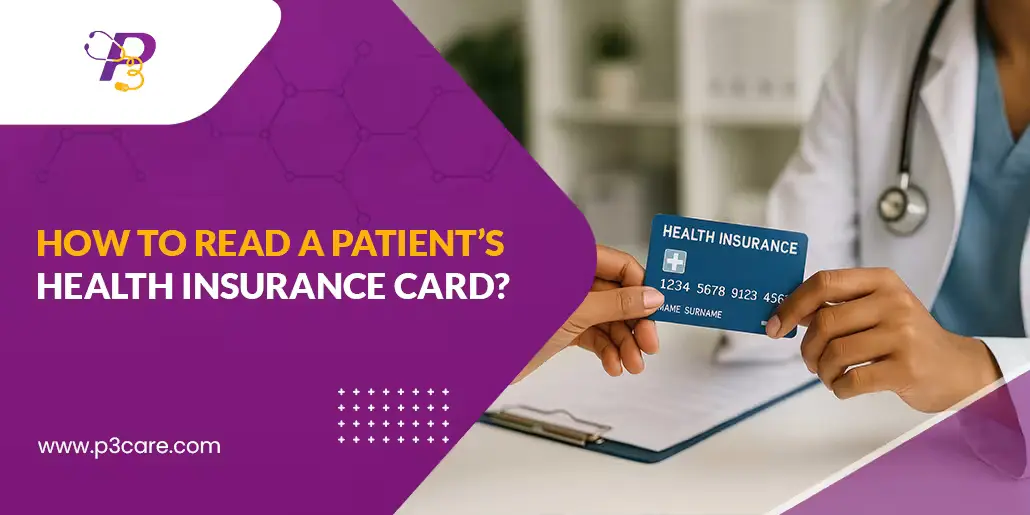
Making a small mistake while reading a patient’s health insurance card may lead to delayed payment for weeks. For the front-desk team, entering the data is a routine task, but the reality is quite different. It determines whether a claim moves forward or gets rejected before the process is even initiated. However, a missed suffix, a wrong payer ID, or even an overlooked plan detail can disturb the complete billing cycle. This aligns with the Medical Group Management Association, which states that front-end inaccuracies, such as wrong insurance information, are a main cause of claim delay or rework. CMS further acknowledges that capturing correct patient information is important in making sure claims are submitted flawlessly.
Revenue cycle management initiates at patient intake. At this stage, errors move downstream, which is difficult to correct. According to the American Medical Association, inaccurate patient or insurance information is one of the main reasons for claim denials.
Suppose a medium-sized health care clinic in Texas reports repeated claim rejections for specialist visits. During an audit, the issue is traced back to inaccurate plan type identification at the intake stage. So, the staff assumed PPO coverage, but the insurance card showed an HMO plan needing referrals.
The underlying problem wasn’t complicated billing; it was misunderstanding the insurance card.
Dealing with front-end claim issues? Smooth your intake process with authority-driven RCM solutions to minimize denials from day one.
Insurers follow the standardized data conventions while card layout changes. Every element offers a particular role when it comes to eligibility verification and claims processing.
The member ID is an insurer-specific unique identifier utilized to associate and link a patient to their coverage. The format of this card vary depending on insurers and their plan types, making exact entry important for the claim process.
Operationally:
Example:
In the case of families, children often have the same root ID but vary in their suffix numbers (e.g., -01, -02). Omitting the suffix number may cause the claims to be filed in the wrong person’s name and may cause the claim rejection or be incorrectly verified.
Billing with several types of payers will cause delays in your billing process. You can outsource your insurance information checks and data entry to increase efficiency.
Furthermore, the group number is often undervalued, but it impacts how benefits are aligned. As per the payer documentation and CMS regulations.
The payer ID ensures that claims are routed to the correct insurance entity through clearinghouses.
The Healthcare Financial Management Association notes that incorrect payer routing is a common source of claim rejection in electronic submissions.
A billing team utilized a default payer ID saved in their system rather than re-checking the updated ID on the card. This procedure may lead to the claim rejection at the clearinghouse level, as they were routed to an inactive payer endpoint.
This information determines the patient’s payment liability.
Copayment: Set charge per visit
Coinsurance: Proportion of overall cost
Proper understanding guarantees:
For a patient with a $50 copay for specialists’ services, $20 is collected erroneously because of misinterpretation. Follow-up billing will be necessary for the outstanding amount.
However, the back card usually contains instructions that directly impact claim processing.
These include:
Often, behavioural health coverage is subcontracted to other vendors. Claims submitted directly to the main insurance carrier rather than to the subcontractor result in automatic denial.
Managing the high patient volumes usually depends on certified RCM partners like P3Care. It helps in maintaining the insurance verification accuracy and reducing front-end errors without disturbing the workflows.
Understanding insurer-specific formats improves efficiency and reduces errors.
UnitedHealthcare cards often include multiple identifiers depending on plan type.
UHC offers multiple network products. Staff must confirm the network name, as it determines provider eligibility and reimbursement rates.
BCBS cards include an alpha prefix that identifies the member’s home plan. The Blue Cross Blue Shield Association states that the prefix is essential for routing claims across its nationwide network.
A missing prefix can redirect a claim to the wrong state plan, causing delays or rejections. This is one of the most frequent front-end errors in multi-state practices.
Aetna cards often include both medical and pharmacy benefit identifiers.
Billing teams must distinguish between the pharmacy and medical fields. Confusing these identifiers leads to incorrect submissions.
Cigna cards commonly include multiple contact pathways.
Submitting a behavioral health claim to the general claims address results in denial. Each service category may have separate processing rules.
Humana cards usually have explicit copayment information but tend to differ widely from plan to plan.
Humana Medicare Advantage plans might have extra stipulations that cannot be seen on the card’s front side. It’s important to check for them.
| Provider | Unique Features | Risk Areas |
| UnitedHealthcare | Multiple network products | Inaccurate network selection |
| BCBS | Alpha prefix system | Claim misrouting |
| Aetna | RX vs medical identifiers | Submission errors |
| Cigna | Multiple contact channels | Incorrect routing |
| Humana | Plan variability | Authorization gaps |
Network information can be gleaned through insurance logos.
Here are some examples:
Overlooking the above can result in:
Patients can also possess more than one insurance policy. Order becomes critical here. In the benefits of coordination, employer-sponsored insurance is often primary when the employer has 20 or more employees. Whereas Medicare usually behaves as secondary and order rely on employment status and particular CMS coordination rules
The determination of the primary insurance provider would be based on the coordination of benefits policy. In most instances, if an employee works for an organization that employs more than 20 individuals, the employer-sponsored insurance is considered primary, while Medicare is secondary.
A government card is very different from a commercial card.
CMS data shows that Medicaid eligibility can be changed often, and it needs to be verified before every visit.
Most front-end errors are the result of assumptions made, rather than limitations of the system.
These include:
According to HFMA, improving front-end data accuracy substantially decreases preventable claim denials and administrative rework.
Digital insurance cards are becoming more prevalent, particularly via insurer mobile applications.
The patient may show an old screenshot. This may result in improper billing without verification.
A well-defined validation procedure ensures consistency and accuracy.
Leading revenue cycle management (RCM) teams adopt this standardized approach.
Reading a patient’s health insurance card is a method that demands consistency rather than assumptions. Every field from member ID to payer routing directly shapes the claim processing cycle through a structure.
On a daily basis, accuracy stems from adhering to a specific method:
When teams adopt such a systematic approach, they can minimize unnecessary mistakes at the point of intake. This eventually leads to better claim acceptance rates, faster reimbursement cycles, and minimized rework. The bottom line is that successful RCM relies heavily on how accurately the insurance card is read at the very first encounter—before any denial happens.
Seeking ways to minimize claim rejections and increase first-time approval rates? Collaborate with P3Care’s trustworthy medical billing staff to enhance your front-end workflow and guarantee proper insurance verification.
The most important is the member ID, as it ties the claim back to the insurance coverage of the patient. But when dealing with actual claims, precision comes from multiple fields together, which includes the payer ID and the plan type. The use of a proper member ID cannot guarantee the accuracy of the payer ID used.
BCBS cards need to be taken care of because of the alpha code that helps identify the correct regional payer. In many cases, the claims are automatically denied because the personnel forgot to add the alpha code.
The front-desk team can minimize denials by checking the insurance immediately but not depending on already secure data. They also need to be very careful while reading both sides of the insurance card. Following the structured checklist and verifying payer IDs before submission also clearly lowers first-pass rejection rates.
Yes, digital cards or online cards are still valid but need careful verification. Patients could show old screenshots or incomplete views. Therefore, staff should check the compulsory details, such as payer ID and member ID, via reliable tools to make sure of accuracy before claim submission.
Assuming the previously saved information is still valid is one of the biggest mistakes. The insurance details vary constantly, and failing to re-check becomes the reason for incorrect medical billing. This usually leads to the denied claims, rework, and delayed repayment.