
Ensuring HIPAA compliance is one of the biggest responsibilities for any medical billing operation. Billing teams handle large amounts of Protected Health Information (PHI), financial data, claim details, and communication with payers — making them a prime target for cyber threats. Yet many practices still fail to conduct proper security risk analysis, even though it’s a mandatory requirement under the HIPAA Security Rule.
This blog breaks down the areas most practices overlook, how to strengthen compliance, and what a complete, billing-specific risk analysis truly requires. Whether you manage billing in-house or work with a partner like p3care, understanding these gaps is essential to protect patients and avoid penalties.
HIPAA compliance means keeping patient data confidential, secure, and accessible only to authorized individuals.
For medical billing, this involves:
Most practices do the basics — but miss deeper, billing-specific vulnerabilities that can lead to breaches.
A major gap in many risk assessments is failing to map the end-to-end billing workflow. PHI moves through multiple points:
Each step carries different risks.
For example:
A proper analysis reviews every handoff, every system, and every integration.
Here are the most overlooked areas in billing-related HIPAA risk assessments:
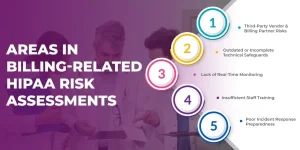
Clearinghouses, billing services, EHR integrations, and payment vendors all touch PHI.
Yet many practices:
Any weak link in the chain can lead to a breach.
Many billing platforms lack essential protections:
Without these safeguards, PHI is vulnerable inside the system even before it leaves the practice.
HIPAA requires ongoing risk management — not a one-time audit.
Yet many billing teams:
Continuous monitoring can catch suspicious activity before it becomes a breach.
Billing staff often handle PHI every day, but training tends to be:
Billing teams need training in:
Companies like p3care emphasize billing-specific HIPAA training to reduce human error — one of the biggest causes of breaches.
Even well-protected practices can face data incidents.
The problem is that many:
A strong incident response plan includes:
Medical billing is not like other healthcare workflows — it has unique risks that general HIPAA audits often ignore. Here’s why a billing-specific compliance approach is absolutely necessary:
Billing departments constantly send PHI:
Every transmission increases exposure.
Without billing-specific controls (secure EDI, encryption, audit trails), PHI is at risk.
Billing touches:
Every integration point is a potential vulnerability.
A generic HIPAA checklist doesn’t cover these interconnected systems.
Billing relies heavily on vendors.
Examples:
Weak vendor security = your liability.
A specialized risk analysis verifies each vendor’s safeguards. This is an area many practices completely overlook.
Billing teams actively manage:
More hands touching PHI → higher risk of errors or unauthorized access.
Billing-specific training reduces human mistakes — the #1 cause of breaches.
Financial information overlap
Billing often includes:
Financial data + PHI combined = higher-value target for cybercriminals.
Most generic audits cover:
But they do NOT test:
This means critical billing vulnerabilities stay hidden.
A billing-focused HIPAA assessment:
Reviews every billing workflow
Evaluates all billing software integrations
Tests EDI and transmission security
Audits third-party vendor risks
Addresses coder/biller access controls
Catches real-world billing vulnerabilities
This is the level of compliance used by specialized RCM companies like p3care, and it ensures risks are identified before they turn into violations.
A strong, well-performed security risk analysis is not only a HIPAA requirement — it is the foundation of a secure, efficient, and trustworthy billing operation. Here is what each benefit truly means:
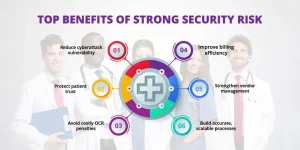
Cybercriminals frequently target billing systems because they contain PHI + financial data.
A proper risk analysis identifies weak passwords, outdated software, unsecured EDI connections, or missing encryption—allowing practices to fix problems before hackers exploit them.
Patients expect their sensitive information to be safe.
If their data is exposed, it damages your reputation instantly.
A thorough risk analysis keeps their information protected at every step of the billing process.
The Office for Civil Rights (OCR) issues penalties when organizations fail to protect PHI — especially when they skip risk analyses.
Penalties can reach millions of dollars.
Risk analysis helps you stay compliant and avoid enforcement actions.
Security isn’t separate from operations.
A cleaner, safer system reduces:
Risk analysis highlights operational gaps that slow down billing and lets teams fix them.
Billing involves many third parties — clearinghouses, RCM companies, and software vendors.
Risk analysis ensures all vendors have proper security, updated BAAs, and secure PHI handling processes.
No single weak partner should compromise your compliance.
Risk analysis forces practices to document workflows, define access roles, and standardize procedures.
This makes your billing system predictable, repeatable, and scalable — especially during growth or technology upgrades.
HIPAA compliance in medical billing is more than just encryption and access control — it requires continuous evaluation of every system, workflow, vendor, and staff process that touches PHI. Most practices overlook key areas like EDI security, third-party risk, monitoring gaps, and workflow vulnerabilities.
By conducting a complete, billing-specific security risk analysis, healthcare organizations can stay protected from breaches, avoid penalties, and build a stronger billing infrastructure.
If you want to ensure your billing operations are compliant, secure, and well-managed, start by reviewing your risk analysis process and addressing the overlooked gaps highlighted above.
It’s a mandatory assessment that identifies potential risks to electronic PHI (ePHI) and outlines steps to reduce those risks. Every medical billing operation must perform it regularly.
Billing teams handle PHI, financial details, and insurance data — all of which must be protected to prevent breaches, penalties, and loss of patient trust.
At least once a year, but quarterly reviews or “mini audits” are recommended because billing systems and threats constantly change.
Unencrypted emails, unauthorized access, outdated software, lack of training, insecure EDI transfers, and weak password practices.
Yes. Any third-party that handles PHI is legally required to sign and maintain an updated BAA.
Yes — if the vendor is certified, trained, and conducts regular risk analyses. Reputable partners help strengthen safeguards and reduce internal workload.