
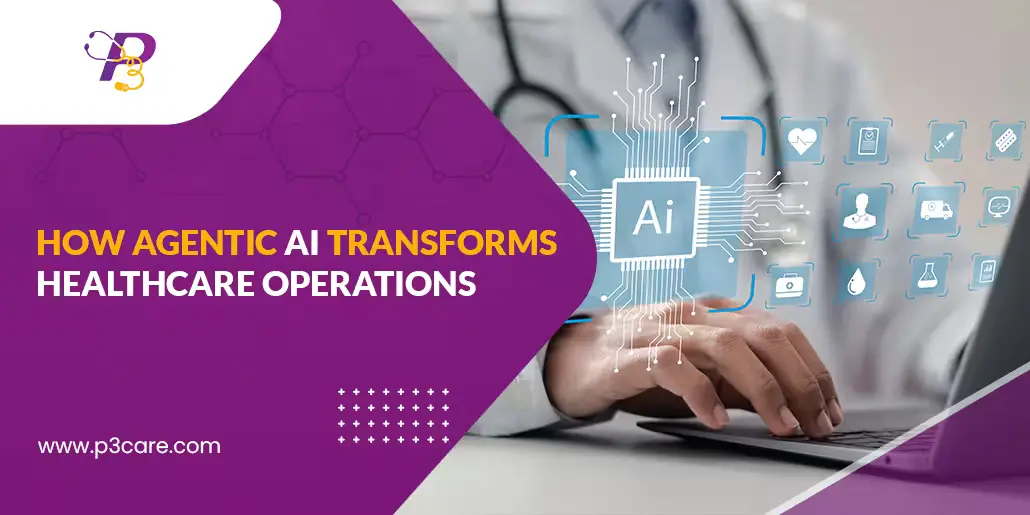
The healthcare industry in 2026 no longer faces the challenges associated with the rigid and “wait and prompt” nature of earlier artificial intelligence solutions. While generative AI was able to capture our attention with its note-taking capabilities, agentic AI in healthcare has proven itself as the ultimate force multiplier, performing multi-step processes without the need for continuous human guidance. As per the latest industry information by BCG, healthcare companies have now moved away from being co-pilots and started using agents to connect administrative data with clinical practice.
“Agentic AI” means the development of AI that possesses “agency”—meaning that it is able to be aware of its surroundings, think through complicated objectives, and act on them independently to accomplish them. Unlike conventional software that relies solely on “if this, then that” logic, an agentic AI is akin to an employee within an IT system. It does not merely give recommendations but rather thinks about how things ought to be done by interacting with other software systems and accomplishing the task.
It is important to understand the difference between the two types of AI. While generative AI is essentially reactive, it needs an input by a person to generate text or code. On the other hand, Agentic AI in healthcare is proactive.
For instance, when a medical coder uses GenAI and asks for the ICD-10 code related to the specific disease, he/she receives an answer to the question. In turn, Agentic AI in healthcare independently checks the record, notices the absence of the code, consults the patient’s notes for more information, changes the claim accordingly, and submits it to the payer.
As such, with medical billing and clinical procedures being highly sensitive and complex matters, there is never a straightforward path that can be taken in any scenario. For example, getting an authorization entails several steps, which include checking benefits, sourcing for clinical documentation, visiting the payers’ portal, and monitoring the application process. The role of agency is allowing the AI to handle the whole sequence of events.
The move toward autonomous operations rests on three technological pillars that distinguish 2026’s infrastructure from the fragmented systems of the past.
Current medical processes are carried out in a swivel-chair process wherein personnel move information between disparate applications. Agentic AI plays the role of the orchestrator here, utilizing its APIs and superior decision-making to transition a patient’s status from ‘Scheduled’ to ‘Checked In’ and ‘Billed’ using the CRM, EHR, and RCM systems.
As FHIR standards mature in 2026, AI agents will be able to analyze information on-the-go. The agent will not simply “read” information but comprehend its meaning. If an agent notices that the blood sugar level of a patient is going down, it will alert the care team, while simultaneously adjusting the patient’s wellness routine.
RCM in 2026 does not focus on the reason behind the claim rejection anymore; it is all about “Pre-emptive RCM.” The agentic system finds any possible conflict between payer requirements even before the claim leaves the organization. By the time a person checks the dashboard for issues, the agent has taken care of 80 percent of the noise.
Insight by the Experts: “The emergence of Agentic AI in healthcare signifies the shift from automation technology to autonomous AI that can manage revenue operations across the organization.”
Revenue Cycle Management (RCM) has seen the most dramatic ROI from Agentic AI. By automating the “cognitive labor” of billing, large practices are seeing unprecedented financial stability.
PA is still one of the leading reasons for physician burnout. Currently, there are AI agents that facilitate the entire PA process.
Result: According to a Salesforce survey conducted in 2025, AI agents were able to cut down the burden of administration by up to 30%.
Example: The physician issues a command to conduct an MRI, and the AI agent verifies the payer’s newest guidelines for 2026 regarding the procedure and includes the pertinent imaging history to submit the request. If the request is denied, then the AI agent reviews the reason code and appeals the request.
Conventional scrubbers focus on hard-coded errors. The agentic AI in healthcare employs “clinical-financial synthesis” to detect sophisticated errors. For example, it can detect that a certain CPT code is not consistent with the seriousness of the disease described in the clinical documentation and correct it to avoid a “hard denial.”
After examining millions of past remits, agents will be able to predict 98% of the time whether the claim will be underpaid, and then this will be marked as an “at-risk” claim and escalated to higher levels of manual scrutiny.
Static billing software leaves money on the table, but autonomous AI agents proactively resolve claim edits and clear backlogs before they impact cash flow. Let P3Care integrate advanced agentic workflows into your practice to maximize operational efficiency.
Automate Your Workflows with AI
The ripple effect of agentic systems extends far beyond the billing office, directly influencing the “point of care.”
The ambient AI scribe technology has transformed into a “clinical agent,” one that does not just transcribe conversations but actively identifies gaps in documentation that may influence the Quality Payment Program (QPP)/MIPS scoring.
The agents continuously track the likelihood of being absent from their scheduled appointments. In the event that one of the patients under high risk has a high chance of not showing up for the appointment, the agent contacts them and offers other options.
After discharge, care can sometimes be forgotten. Agentic AI handles the “patient journey” by reaching out to patients in their preferred mode of communication, helping with medication questions in accordance with clinical guidelines, and alerting nurses only once critical signs have been observed.
| Feature | Traditional Automation (RPA) | Agentic AI (2026 Standard) |
| Logic Basis | Rule-based (If A, then B) | Goal-based (Reasoning & Adaptation) |
| Handling Complexity | Fails on “Edge Cases” | Reasons through unexpected obstacles |
| System Interaction | Hard-coded integrations | Dynamic API and UI interaction |
| Human Role | Constant monitoring & troubleshooting | High-level oversight (Human-in-the-loop) |
| Learning | Static until manually updated | Continuous learning from feedback loops |
Autonomy brings the requirement for stringent control. The move towards the creation of an agentic system by 2026 necessitates a “Trust-First” structure.
Agents should run in encrypted vaults. For instance, in 2026, it is not only a matter of encrypting data but also of ensuring “execution integrity.” Companies need to track all decisions made by the autonomous agent in an audit trail, and the information should only be accessed in line with the minimum necessary rule.
The human is never taken out of the equation but rather brought to the forefront through what is known as the “Human-in-the-Loop” (HITL). In the HITL model, although the agents complete 90% of the workload, there is always a human to verify the decision.
The Autonomous Healthcare Organization (AHO) will become apparent by the end of 2026. The AHO will have a management system where the back office operates automatically. As a result, the AHO can manage more patients without increasing its administrative capacity proportionally.
For larger multispecialty practices, agentic AI can no longer be considered a luxury but becomes a matter of survival in the world of “value-based care.”
With the elimination of the drudgery of making calls to payers and correcting data-entry mistakes, practices claim a 40% improvement in employee morale.
They don’t feel fatigue. They put the same amount of effort into reviewing the thousandth application of the day as the first one, minimizing the “compliance risk” related to human mistakes in ICD-10 and CPT code processing.
According to the National Bureau of Economic Research, AI implementation in the United States can save the country as much as $360 billion per year. In relation to a large-scale office, this means decreased cost of collection and a healthier bottom line.
Ready to lead the future of healthcare? Contact P3care to see how we integrate Agentic AI into your practice’s workflow.
The shift to agentic AI in healthcare involves the need for a partner who is sensitive to the intricacies of billing systems as well as the intricacies involved in developing autonomous systems. The role played by P3care cannot be overstated since the company will serve as your bridge to the future of AI. We do not just provide you with software; we offer the guidance you need to successfully implement human-in-the-loop systems that ensure HIPAA compliance and enhance RCM effectiveness.
No. The former responds to queries, while the latter executes actions. While the chatbot can inform you of your balance, the AI agent is capable of recognizing the cause of the balance, communicating with the insurance company to correct an erroneous code, and updating your statement.
Agentic AI systems have been designed to comply with the “privacy by design” principle in 2026. All PHI is handled in HIPAA-compliant cloud servers under end-to-end encryption. P3care logs all agent communications for auditing purposes.
AI bots do the boring jobs that your employees hate. This frees up time for your billing staff to concentrate on handling difficult appeals, creating strategic plans, and advocating for patients—areas that call for a human touch.
Larger practices generally have an ROI after 6-12 months, largely owing to a 20-30% decrease in the number of denials and a greatly reduced “Cost to Collect,” resulting from the automation of processes.
Thanks to P3Care’s straightforward integration procedure, the vast majority of practices will be able to roll out their initial batch of robotic agents (either for eligibility or prior auth) in less than 60 days.