

A behavioral health practice completes a full psychiatric diagnostic evaluation. Two weeks later, the payer denies the claim; no clear reason, just a rejection code and a shrinking cash flow. This happens with CPT code 90791 more than almost any other behavioral health code, mostly because the evaluation, the diagnosis, and the claim form all have to line up perfectly.
This guide covers what 90791 actually means, how it differs from 90792, which ICD-10-CM codes support it, the documentation payers expect, and the specific errors that trigger denials.
CPT 90791 is the code for a psychiatric diagnostic evaluation performed without medical services. The American Medical Association defines it as an integrated biopsychosocial assessment covering history, mental status, and clinical recommendations. Psychiatrists, psychologists, licensed clinical social workers, licensed professional counselors, and other qualified behavioral health providers use it, usually at intake, before a treatment plan exists. It’s an evaluation code, not a therapy code; it can’t stand in for a psychotherapy session, even when the two happen close together in a patient’s care.
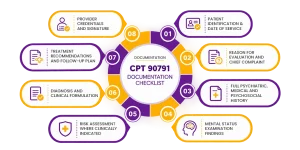
A compliant psychiatric diagnostic evaluation covers four core components:
There’s no fixed time requirement for 90791, though most evaluations run 50–90 minutes. Medical necessity review focuses less on the clock and more on whether these four elements are documented clearly enough to justify the code.
Providers often treat these codes as interchangeable. They aren’t.
| Comparison Points | CPT 90791 | CPT 90792 |
| Service | Psychiatric diagnostic evaluation | Psychiatric diagnostic evaluation with medical services |
| Medical component | None | Exam elements tied to medical decision-making |
| Typical biller | Psychologist, LCSW, LPC, LMFT | Psychiatrist, NP, PA with prescribing authority |
| Same-day psychotherapy | Not billed together | Not billed together |
The distinction most guides gloss over: 90792 isn’t “90791 plus a physical exam.” It requires medical decision-making and risk assessment that only a prescribing provider’s scope of practice supports. Billing 90792 under a non-prescribing clinician’s NPI is one of the fastest ways to trigger a payer audit, even when the documentation looks thorough.
90791 isn’t paid on the strength of the CPT code alone; the linked ICD-10-CM diagnosis must support medical necessity. Common diagnosis families for behavioral health evaluations include:
No single diagnosis code makes 90791 automatically payable. Payers check whether the documented symptoms, history, and clinical formulation genuinely support that diagnosis on that date of service. Practices that treat ICD-10 selection as a coding afterthought, rather than part of the clinical write-up, see a disproportionate share of 90791 denials. P3Care’s medical coding services build that diagnosis-to-CPT linkage into the intake workflow itself.
A defensible 90791 chart includes:
Modifiers worth knowing:
Place of service: POS 02 applies when the patient is somewhere other than home for telehealth; POS 10 applies when the patient is at home. Some state Medicaid behavioral health carve-outs use HCPCS H0031 (mental health assessment, by non-physician) instead of 90791; confirm which code set the specific MCO requires. No modifier or POS rule here is universal; payer and state policy make the final call. Accurate, defensible documentation is the foundation of P3Care’s HIPAA-compliant billing workflow.
For a broader look at behavioral health coding, see our complete guide to Mental Health CPT Codes.
The most common 90791 billing errors:
A second 90791 for the same patient isn’t automatically a duplicate. CMS guidance allows repeat diagnostic evaluations when a significant clinical change or a real gap in care justifies a fresh workup; the chart has to say so explicitly, in the provider’s own clinical language, not just as a billing note.
Clean 90791 billing follows one workflow, start to finish:
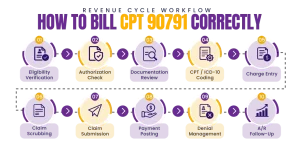
Skip a step and the risk shifts downstream: an eligibility miss becomes a denial three weeks later instead of a same-day fix. This is the workflow P3Care runs for behavioral health practices through its mental health billing services, pairing certified coders with denial-management specialists who already know how payers treat 90791 and 90792 differently.
CPT 90791 billing looks simple on paper: One evaluation & one code. In practice, the diagnosis linkage, the documentation, the modifier, and the payer’s own rules all have to hold up together, or the claim comes back. Getting it right the first time protects both the clinical record and the practice’s cash flow. That’s the difference between a denial letter and a paid claim.
What is CPT code 90791?
The code for a psychiatric diagnostic evaluation performed without medical services, typically the first behavioral health visit before treatment begins.
What’s the difference between 90791 and 90792?
90792 includes a medical services component and is generally billed by prescribing providers; 90791 doesn’t include that component.
Can 90791 be billed with psychotherapy on the same day?
Generally no. An evaluation and a therapy session represent different services, and most payers won’t reimburse both for the same encounter.
Can CPT 90791 be billed via telehealth?
Yes, with the correct modifier (95 or 93) and POS code (02 or 10). Specific rules vary by payer and state.
What ICD-10 codes pair with 90791?
Codes from the F01-F99 range matching the documented diagnosis, commonly mood, anxiety, psychotic, and substance use disorder categories.
Can 90791 be billed more than once for the same patient?
Yes, when a significant clinical change or a documented gap in care justifies a new diagnostic evaluation. The chart needs to state the reason.
Does 90791 require prior authorization?
Not always. Many commercial and Medicare plans treat it as routine, but some behavioral health carve-outs require authorization for every initial evaluation.
What causes most 90791 denials?
Weak diagnosis-to-documentation linkage, duplicate evaluations, and provider credentialing gaps top the list.
Who can bill CPT 90791?
Psychiatrists, psychologists, licensed clinical social workers, licensed professional counselors, and other qualified behavioral health providers acting within their state scope of practice.