Quick answer: Mental health CPT codes are five-digit codes from the American Medical Association that describe behavioral health services. The core set includes 90791 and 90792 (psychiatric diagnostic evaluations), 90832, 90834 and 90837 (individual psychotherapy by time), 90833, 90836 and 90838 (psychotherapy add-ons with an E/M visit), 90839 and 90840 (crisis psychotherapy), and 90846, 90847 and 90853 (family and group psychotherapy). Each claim pairs the CPT code with an ICD-10-CM diagnosis and any modifier the payer requires.
Introduction:
A 52-minute session billed as 90837 comes back denied. A telehealth claim pays at the wrong rate over one place-of-service code. A psychiatric visit with psychotherapy gets paid as an E/M alone. If your team sees these every month, you are not alone.
Mental health CPT codes look simple. Small gaps in psychotherapy time documentation, ICD-10-CM diagnosis linkage, and telehealth modifiers quietly drain revenue from behavioral health practices. The 2027 billing year adds new pressure:
- A lower proposed Medicare conversion factor.
- A new CPT code set.
- New telehealth modifiers.
- An in-person visit deadline on January 1, 2028.
This guide puts everything in one place:
- The most common mental health CPT codes and their exact time rules.
- The 2027 changes that affect psychiatry and therapy claims.
- The ICD-10-CM, HCPCS, and modifier choices that sit beside each code.
- A pre-submission checklist that stops avoidable denials.
It comes from the certified coders behind P3Care’s mental health billing services, who work these claims every day.
What Are Mental Health CPT Codes & How Do They Work With ICD-10 & HCPCS?
Mental health CPT codes report what service you performed. They belong to the Current Procedural Terminology (CPT) code set, maintained by the American Medical Association (AMA). The main annual update takes effect every January 1. Most psychiatry and psychotherapy codes sit in the 90785-90899 range.
A clean behavioral health claim tells one consistent story across four layers:
- CPT (HCPCS Level I): What was done. Example: 90834 for a 45-minute psychotherapy session.
- ICD-10-CM: Why it was done. Example: F41.1 for generalized anxiety disorder.
- Modifiers: Special circumstances. Example: 95 for a synchronous video visit, when the payer asks for it.
- HCPCS Level II: Services, drugs and programs CPT does not describe. Example: J0013 for esketamine nasal spray.
The Centers for Medicare & Medicaid Services (CMS) manages HCPCS Level II. The National Center for Health Statistics (NCHS) maintains ICD-10-CM with CMS.
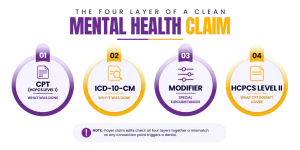
Why this matters: Payer claim edits check all four layers together. A correct CPT code paired with a vague diagnosis or the wrong place of service still fails. Most mental health denials happen at the connection points between layers, not inside a single code.
What Changes in Mental Health Billing for 2027?
Four areas change the most:
- The CPT 2027 code set
- The CY 2027 Medicare Physician Fee Schedule
- Telehealth rules heading into 2028
- Payer prior authorization technology
CPT 2027 (effective January 1, 2027)
- The AMA’s 2027 release includes 299 new codes, 74 revisions and 80 deletions.
- Adaptive behavior (ABA) services see the biggest behavioral health shift. The release adds six new codes (97148, 97149, 97159, 97160, 97173 and 97180) and revises guidance for 97151-97158.
- Review psychiatry and psychotherapy templates against the new code book before your first January claims.
CY 2027 Medicare Physician Fee Schedule (proposed July 14, 2026)
- Proposed conversion factors: $32.8409 standard and $33.1693 for qualifying APM participants. The drop reflects the end of the one-year 2.5% increase from 2026.
- Psychotherapy RVUs: 2027 is the final year of CMS’s four-year work RVU increase for timed behavioral health services, including psychotherapy. That step can soften the conversion factor drop for 90832-90838. Model your top codes once final rates post.
- G2211: CMS proposes turning the add-on into a percentage-based payment modifier.
- New telehealth modifiers: BB would flag telehealth delivered through certain contracted or paid virtual platforms. BC would flag telehealth furnished incident to a practitioner’s service. Both are informational and do not change payment.
- CPT process: CMS requested public input on the CPT coding and valuation process. Nothing changes for 2027 claims.
Details sit in the CMS CY 2027 Physician Fee Schedule proposed rule fact sheet. Treat these items as proposals until the final rule arrives, usually around November 1.
Telehealth heading into 2028
- Medicare telehealth flexibilities run through December 31, 2027.
- The in-person visit requirement for home-based mental health telehealth starts January 1, 2028. Use 2027 to build in-person visit tracking for every Medicare telehealth patient.
- Home-based behavioral health telehealth is a permanent Medicare benefit.
- Audio-only stays available when the clinician can use video and the patient cannot or will not.
Prior authorization and privacy
- Medicare Advantage, Medicaid, CHIP and marketplace plans face a January 2027 deadline for prior authorization APIs under the CMS Interoperability and Prior Authorization rule (CMS-0057-F). Expect more electronic authorizations for testing and intensive programs.
- 42 CFR Part 2 updates took effect February 16, 2026. Confirm your consent forms cover treatment, payment and health care operations before billing substance use disorder services.
ICD-10-CM
- FY2027 codes took effect October 1, 2026, and apply to dates of service through September 30, 2027.
- The FY2028 update arrives October 1, 2027.
Which Mental Health CPT Codes Are Used Most Often?
These common psychiatric CPT codes cover most outpatient behavioral health billing.
Psychiatric diagnostic evaluation
- 90791: Evaluation without medical services.
- 90792: Evaluation with medical services.
Individual psychotherapy
- 90832: About 30 minutes.
- 90834: About 45 minutes.
- 90837: About 60 minutes.
Psychotherapy add-ons with E/M
- 90833, 90836, 90838: Psychotherapy time added to a same-day E/M visit.
Crisis, family and group services
- 90839: Psychotherapy for crisis, first 60 minutes.
- 90840: Each additional 30 minutes of crisis care.
- 90846: Family psychotherapy without the patient present.
- 90847: Family psychotherapy with the patient present.
- 90849: Multiple-family group psychotherapy.
- 90853: Group psychotherapy (other than multiple-family).
Supporting and related services
- 90785: Interactive complexity add-on
- 96127: Brief emotional or behavioral assessment, per standardized instrument
- 96130–96131: Psychological testing evaluation services
- 99484 and 99492–99494: General behavioral health integration and psychiatric Collaborative Care Management
- 97151–97158, plus six new 2027 codes: Adaptive behavior assessment and treatment
Mental Health CPT Codes by Service (2027 Quick Reference)
| Service |
CPT codes |
Time rule or key requirement |
Common denial trigger |
| Diagnostic evaluation |
90791, 90792 |
Not time-based; 90792 needs medical services by a prescriber |
Billed same day as psychotherapy or E/M by the same provider |
| Individual psychotherapy |
90832, 90834, 90837 |
16-37 min, 3-52 min, 53+ min |
Booked slot billed instead of documented minutes |
| Psychotherapy with E/M |
90833, 90836, 90838 |
Same time bands; E/M level chosen by MDM |
Psychotherapy time not separated from E/M work |
| Crisis psychotherapy |
90839, 90840 |
90839 at 30-74 min; add 90840 at 75 min and again at 105 min |
Sessions under 30 minutes billed as crisis |
| Family psychotherapy |
90846, 90847 |
26+ minutes; note ties the session to the patient’s treatment |
Couples work with no identified patient diagnosis |
| Group psychotherapy |
90853, 90849 |
Reported per patient, per session |
No individual note for each group member |
| Interactive complexity |
90785 |
Add-on to 90791, 90792, 90832–90838 or 90853 only |
Added routinely with no documented complicating factor |
| BHI and CoCM |
99484, 99492-99494 |
Monthly time thresholds and patient consent |
Missing consent or time log |
How Do You Choose Between 90832, 90834 and 90837?
Choose the psychotherapy CPT code by documented face-to-face psychotherapy time, using the CPT midpoint rule. The booked appointment length does not count.
- Under 16 minutes: no psychotherapy code
- 16-37 minutes: 90832
- 38-52 minutes: 90834
- 53 minutes or more: 90837
The 50-minute trap: the classic “therapy hour” of 50 minutes is 90834, not 90837. A 52-minute session is still 90834. Two or three undocumented minutes are the most common reason a 90837 claim fails review.
Document these items for every session:
- Start and stop times, or total psychotherapy minutes.
- Modality and interventions used (CBT, DBT, EMDR and others).
- Patient response and progress toward goals.
- A current, signed treatment plan.
The “8-minute rule” belongs to certain timed rehabilitation codes. It does not apply to psychotherapy.
Sessions past 90 minutes: Medicare contractor billing guidance pays extended sessions only when the record documents the face-to-face time and the medical necessity for that length.
Federal auditors watch these claims closely. A nationwide HHS Office of Inspector General (OIG) audit estimated $580 million in improper Medicare psychotherapy payments during the first pandemic year. Missing psychotherapy time and incomplete treatment plans ranked among the top problems.
What Is the Difference Between 90791 and 90792?
Both codes report a psychiatric diagnostic evaluation. The difference is medical services.
- 90791 covers history, mental status exam and treatment recommendations. Psychologists, LCSWs, LPCs, LMFTs and prescribers can bill it within their scope.
- 90792 adds medical work such as a medical review, physical exam elements, prescribing or lab orders. Only prescribers should bill it: psychiatrists, psychiatric nurse practitioners, and PAs where state scope allows.
Rules to remember:
- Neither code is time-based.
- Report one evaluation per day.
- Don’t bill 90791 or 90792 with a psychotherapy code or an E/M on the same day by the same provider.
- Medicare contractor guidance ties the evaluation to the onset of an illness or suspected illness. A repeat evaluation needs a documented reason, such as a significant change in condition.
Prescriber insight most guides skip: for a new patient, a psychiatric prescriber can often choose between 90792 and a new-patient E/M code (99202-99205). Only the E/M route allows 90833-90838 for same-day psychotherapy. Compare documentation needs and fee schedules before you build your intake template.
How Do You Bill Psychotherapy With an E/M Visit?
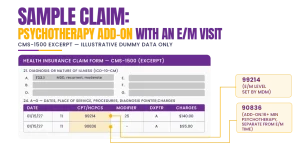
Report the E/M code and add 90833, 90836 or 90838 for the psychotherapy portion. These are add-on codes and never stand alone.
- The E/M must be significant and separately identifiable.
- Psychotherapy must last at least 16 minutes, counted apart from E/M work.
- Choose the E/M level by medical decision making (MDM), not total time. Time cannot count toward both services.
- The same time bands apply: 90833 (16-37 min), 90836 (38-52 min), 90838 (53+ min).
- Most payers don’t require modifier 25 on the E/M for this pairing. A few commercial plans do.
- Don’t report crisis codes or 90791/90792 with this combination on the same day.
- Medicare’s G2211 complexity add-on may apply to the E/M for ongoing psychiatric care. Watch the CY 2027 final rule for its proposed restructuring.
Example: a psychiatrist adjusts an antidepressant (moderate MDM) and provides 40 minutes of supportive psychotherapy. The claim shows 99214 + 90836, linked to F33.1.
Which ICD-10-CM Codes Support Mental Health Claims in 2027?
Mental health ICD-10 codes come from Chapter 5 of ICD-10-CM (F01–F99). The code must match the condition the clinician documented. It is never chosen to fit a payment rule.
Main F-code categories
- F01-F09: Mental disorders due to known physiological conditions.
- F10-F19: Substance use disorders.
- F20-F29: Schizophrenia and other psychotic disorders.
- F30-F39: Mood disorders.
- F40-F48: Anxiety, stress-related and related disorders.
- F50-F59: Behavioral syndromes with physiological factors.
- F60-F69: Adult personality and behavior disorders.
- F70-F79: Intellectual disabilities.
- F80-F89: Developmental disorders.
- F90-F98: Disorders with childhood onset, including ADHD.
Frequently billed codes
- F32.9: Major depressive disorder, single episode, unspecified.
- F33.1: Major depressive disorder, recurrent, moderate.
- F41.1: Generalized anxiety disorder.
- F41.9: Anxiety disorder, unspecified.
- F43.10/F43.12: PTSD, unspecified/chronic.
- F43.23: Adjustment disorder with mixed anxiety and depressed mood.
- F90.9: ADHD, unspecified type.
Diagnosis details that change outcomes
- F32.9 vs. F32.A: F32.A means “depression, unspecified.” It is not a major depressive disorder code, so a payer policy written around MDD may reject it.
- Specificity supports care: unspecified codes are valid. Documented detail such as recurrent, severity or chronic supports longer or more intensive treatment.
- Z codes (Z55–Z65) capture social factors like housing or job stress. Use them as secondary codes. They rarely support payment alone.
- Diagnosis pointers: link each CPT line to the diagnosis that drove that service.
FY2027 code set (October 1, 2026; September 30, 2027)
- The release adds 190 codes and deletes 30.
- Only one new code lands in the F chapter (F64.A).
- New Z77 exposure codes for burn pits, Agent Orange, and blast overpressure can add documented context for veterans in PTSD or trauma-focused care.
- Instructional notes changed across the Tabular List, so recheck Excludes1 and Excludes2 notes on your top diagnoses.
- Download the official files from the CDC NCHS ICD-10-CM page.
Which Modifiers & Place-of-Service Codes Do Mental Health Claims Need?
Mental health billing modifiers depend on the payer, setting and modality. No single modifier fits every plan.
Core modifiers
- 25: Significant, separately identifiable E/M on the same day as another service.
- 59 or XE/XS/XP/XU: A distinct service that would otherwise trip a National Correct Coding Initiative (NCCI) edit.
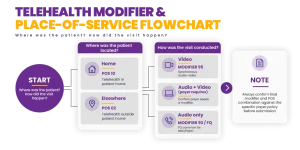
- 95: Synchronous audio-video telehealth, when the payer requires it.
- 93: Synchronous audio-only service.
- FQ: Audio-only indicator on certain Medicare claims, most often RHC and FQHC mental health visits.
- GT: Legacy video modifier. Medicare limits it to CAH Method II institutional claims, and a few commercial plans still request it.
- BB and BC (proposed for January 1, 2027): Medicare flags for telehealth through certain virtual platform arrangements (BB) or incident-to telehealth (BC).
Medicaid HCPCS modifiers (state rules vary)
- HO / HN / HP: Master’s, bachelor’s or doctoral-level clinician.
- HE: Mental health program.
- HQ: Group setting.
- HR / HS: Family or couple session with or without the client present.
Place of service
- POS 10: Telehealth in the patient’s home, usually paid at the non-facility rate.
- POS 02: Telehealth outside the patient’s home.
- POS 11: Office visit.
- POS 53: Community mental health center.
Telehealth documentation tips
- The CMS Telehealth FAQ confirms the requirement applies after December 31, 2027.
- For audio-only visits, write the reason video was not used in the note.
- 90849 remains on the Medicare Telehealth Services List after its 2026 addition.
- If your clinicians see patients through a contracted therapy platform, confirm BB applicability with your billing team before January.
Do Mental Health Services Use HCPCS Level II Codes?
Yes. HCPCS Level II mental health codes appear when Medicare, Medicaid or a drug-based treatment needs a code CPT does not provide.
Medicare G-codes
- G0323: Behavioral health care management by clinical psychologists, clinical social workers, MFTs or mental health counselors, 20+ minutes per month.
- G0017/G0018: Crisis psychotherapy furnished in certain non-facility locations outside the office.
- G0552-G0554: Digital mental health treatment devices, including FDA-cleared ADHD digital therapy devices since 2026.
- G0568/G0569 / G0570: CoCM and general BHI add-ons to Advanced Primary Care Management (APCM).
- G2082 / G2083: Supervised esketamine sessions for Medicare (up to 56 mg / more than 56 mg), with observation bundled in.
Myth to correct: G0568-G0570 do not replace 99484 or 99492-99494. They apply only when the same practitioner bills the APCM base code for the same patient in the same month. Outside APCM, the CPT codes remain the right choice.
Drug codes
- J0013: Esketamine nasal spray, 1 mg. It replaced S0013 on January 1, 2026. Units equal milligrams given. Medicare generally uses the G2082/G2083 bundles.
- J2426: Paliperidone palmitate extended-release, 1 mg, reported with 96372 for the injection where payer rules allow.
Medicaid H-codes (defined state by state)
- H0031: Mental health assessment by a non-physician.
- H0004: Behavioral health counseling, per 15 minutes.
- H2011: Crisis intervention, per 15 minutes.
- H2019: Therapeutic behavioral services, per 15 minutes.
Why Do Mental Health Claims Get Denied & and How Can You Prevent It?
Most mental health claim denials trace back to a short list of preventable errors.
- Wrong time code: Billing the booked slot, not the documented minutes.
- Missing time or treatment plan: Top findings in federal psychotherapy audits.
- Diagnosis mismatch: Vague, outdated or deleted ICD-10-CM codes.
- Same-day conflicts: 90791 with psychotherapy, or crisis codes with other psychotherapy codes.
- 90785 overuse: Added without a documented communication barrier
- POS and modifier errors: POS 02 used for a home visit, or audio-only billed with no documented reason.
- Behavioral health carve-outs: Many commercial plans route mental health benefits to a separate behavioral health administrator. A claim sent to the medical plan’s payer ID gets denied even with perfect coding.
- Missing prior authorization: Common for psychological testing, extended sessions and intensive programs.
- Credentialing gaps: MFTs and mental health counselors have been able to bill Medicare since January 1, 2024. Each clinician must be enrolled before the date of service.
- Underbilling: Skipped add-ons, 90834 billed when 90837 is documented, or unbilled BHI time.
- Overbilling risk: Routine 90837 or high-level E/M without support draws audits.
- Weak follow-up: Unworked denials and aging AR turn fixable claims into write-offs.
The 2026-2028 behavioral health billing calendar
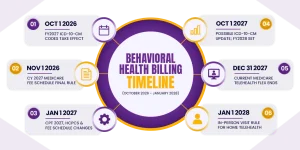
- October 1, 2026: FY2027 ICD-10-CM codes take effect.
- Around November 1, 2026: CY 2027 fee schedule final rule expected.
- January 1, 2027: CPT 2027, HCPCS and fee schedule changes; proposed BB/BC modifiers; payer prior authorization APIs.
- April 1 and October 1, 2027: possible ICD-10-CM update and the FY2028 code set
- December 31, 2027: current Medicare telehealth flexibilities end.
- January 1, 2028: in-person visit requirement for home-based mental health telehealth begins.
A 6-Point Pre-Submission Checklist
- Verify eligibility and check for a behavioral health carve-out.
- Confirm prior authorization and visit limits.
- Match the CPT code to documented minutes or components.
- Link a current, specific ICD-10-CM code to each line.
- Match the modifier and POS to the patient’s location and the visit modality.
- Confirm the rendering clinician is credentialed with that payer.

How Does P3Care Support Mental Health Revenue Cycle Management?
P3Care connects accurate coding to every step after it. Accurate coding leads to cleaner claims, fewer avoidable denials, and clearer revenue visibility. Coding alone does not guarantee payment, so our team manages the full revenue cycle management process.
- Coding and audits: Certified medical coding services with CPT, ICD-10-CM, HCPCS and modifier review.
- Front-end checks: Eligibility, carve-out and prior authorization verification.
- Claim submission: Through our end-to-end medical billing services.
- Denials: Root-cause fixes and appeals through denial management services.
- Posting and AR: payment posting, underpayment review and accounts receivable management.
- Enrollment: Provider credentialing for psychiatrists, psychologists, LCSWs, MFTs and counselors.
- Compliance: HIPAA medical billing built for sensitive behavioral health records.
- Quality programs: MIPS reporting services.
Our cloud platform, P3Merge, supports this work:
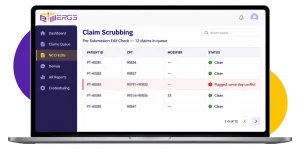
- Scrubs claims against NCCI edits and payer-specific rules before submission
- Tracks every claim in real time
- Auto-posts ERAs
- Surfaces denial patterns in AR reports
Conclusion
Mental health billing in 2027 rewards precision:
- Match every code to documented time or components.
- Link a specific, current diagnosis.
- Use the modifier and place of service each payer expects.
- Prepare now for the January 1, 2028, in-person requirement.
P3Care’s certified team can take this workload off your desk. Contact P3Care to schedule a 2027 readiness consultation, explore all P3Care services, or read more coding guides on the P3Care blog.
Ready to Simplify Your Mental Health Billing?
Keep your CPT, ICD-10-CM, HCPCS, modifier, and claim workflows accurate with P3Care. Our billing experts help reduce avoidable denials and keep your revenue cycle moving.
Talk to Our Billing Experts
FAQs
Can a therapist bill two psychotherapy sessions for one patient on the same day?
Most payers allow one individual psychotherapy code per patient, per provider, per day. Some accept a second, clearly separate session with modifier 59 or XE and full documentation.
What CPT codes are used for psychological testing?
Use 96130-96131 for testing evaluation, 96136-96137 for administration by a psychologist or physician, and 96138-96139 for administration by a technician. Many payers require prior authorization.
Which code covers depression or anxiety screening?
CPT 96127 reports each brief standardized instrument, such as the PHQ-9 or GAD-7. Medicare uses G0444 for annual depression screening.
Is couples therapy billable to insurance?
CPT 90847 applies when the session treats an identified patient’s diagnosed condition. Relationship counseling without a diagnosis is rarely covered.
Does Medicare cover mental health services?
Yes. Medicare Part B covers medically necessary psychiatric evaluations, psychotherapy, medication management and integrated care. Patients typically owe 20% coinsurance after the Part B deductible. Medicare Advantage plans may add authorization rules.
Can I charge a patient for a missed therapy appointment?
No CPT code exists for a no-show. Medicare allows a missed-appointment fee billed to the patient only when the same written policy applies to all patients.
What codes apply to intensive outpatient mental health programs?
Commercial plans often use per diem HCPCS codes such as S9480. Medicare’s intensive outpatient benefit, active since 2024, is billed on institutional claims by hospitals, CMHCs, FQHCs and RHCs.
How fast do Medicare mental health claims pay?
Clean electronic Medicare claims pay no earlier than the 14th day after receipt and usually within 30 days. Commercial timelines follow contracts and state prompt-pay laws.
How often should a behavioral health practice audit its coding?
A quarterly sample audit works well for most practices. Add a focused review after each January CPT update and each October ICD-10-CM update.
Can I bill 90837 every week?
Yes, when each session meets the time rule and medical necessity supports the length. Some commercial payers monitor high 90837 volume and may request records or require authorization for extended sessions. Check each contract.