


Navigating the financial backbone of healthcare can feel like moving through a maze blindfolded. Did you know that the national average initial claim denial rate hovers between 9% and 12%, with more than 40% of providers reporting denial rates exceeding 10%? Even more alarming, roughly 60% to 65% of those initially denied claims are never successfully reworked or appealed, leading to permanent revenue leakage for medical practices.
To keep your practice financially healthy, you need a crystal-clear understanding of how medical claims move from a simple patient handshake all the way to a paid invoice.
The claim submission process is the formal, standardized procedure through which healthcare providers communicate the services rendered to an insurance payer to request reimbursement. It acts as the financial bridge between clinical care and practice revenue, translating medical diagnoses and treatments into structured data that insurance companies use to evaluate and issue payment.
According to the Centers for Medicare & Medicaid Services (CMS), every medical claim relies on a specific set of core data elements to pass initial muster with a payer:
A medical claim does not just magically appear on an insurance adjuster’s desk. It travels through a structured lifecycle that begins long before the provider enters the examination room and ends long after the patient leaves.
The journey starts at front-desk scheduling and registration, moves into clinical documentation and medical coding, flows through charge entry, electronic claim scrubbing, and clearinghouse transmission, and finally lands on payer adjudication desks. Once processed, it returns as an Electronic Remittance Advice (ERA), setting the stage for payment posting and proactive denial management
Tired of chasing down unpaid claims and dealing with preventable rejections? Let our automated scrubbing and verification tools keep your workflow smooth.
Schedule a Free Billing Audit
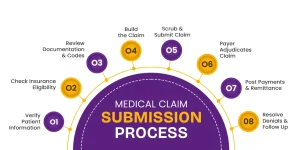
Verifying this information before the claim is created is vital. According to industry analyses by groups like the Medical Group Management Association (MGMA), front-end administrative errors account for the vast majority of claim issues. Entering an incorrect date of birth, misspelled name, or transposed member ID guarantees that the payer’s automated system will immediately reject the claim before it ever reaches a human reviewer.
Eligibility verification prevents avoidable billing problems by ensuring the patient’s plan is active and that the specific service is covered under their contract. Catching an inactive policy or a missing referral upfront spares the practice weeks of chasing uncollectible balances.
Provider documentation must rigorously support the services billed. Coders rely on three foundational coding systems:
Coding must accurately reflect clinical documentation without upcoding or unbundling. Furthermore, medical necessity dictates that the services performed are reasonably necessary for the diagnosis or treatment of an illness or injury under standard medical guidelines.
Coded services are translated into itemized billable charges. The built claim aggregates patient and provider details, diagnosis codes, procedure codes, modifiers, dates of service, units, charges, and place of service codes. Professional claims are typically formatted on the CMS-1500 paper form or transmitted electronically as 837P files, while institutional billing uses the UB-04 or 837I formats.
Claim scrubbing is an automated pre-submission review process that checks claims against payer rules, coding edits, and demographic requirements to flag errors. Common checks include missing data fields, invalid code combinations, and demographic mismatches.
Once scrubbed, a clearinghouse acts as an intermediary, translating data into standardized electronic formats and transmitting claims securely to payers. It is important to distinguish between rejections and denials: a rejection happens before adjudication because the claim fails formatting or data checks, whereas a denial occurs when the payer fully processes the claim but refuses payment.
Once a payer receives a claim, adjudication begins. The payer evaluates eligibility, benefits, coding accuracy, medical necessity, contract terms, and historical claims. Outcomes typically include:
Providers track these updates via claim status portals and review incoming Electronic Remittance Advice (ERA) documents.
Payment posting reconciles incoming money against outstanding accounts receivable (A/R). Staff reviews the Electronic Remittance Advice ERA or Explanation of Benefits (EOB) to match payer payments against billed charges, carefully noting allowed amounts, contractual adjustments, insurance payouts, patient responsibilities, and partial denials. Accurate payment posting is essential for maintaining clean financial reporting and transparent patient billing cycles.
Claim submission does not end the moment a file leaves your system. Common denial reasons include eligibility lapses, missing prior authorizations, coding mismatches, duplicate submissions, and missed timely filing windows. Basic denial management involves identifying the root cause, correcting the underlying error, submitting a corrected claim or formal appeal, and tracking the outcome until resolution.
Simple typos in the patient’s date of birth, member ID, legal name, or group policy details are prime culprits behind instant rejections.
Using mismatched diagnosis-procedure pairings, failing to apply required modifiers, or submitting unsupported codes will prompt payer flags.
Failing to secure prior authorization before rendering specialized or high-cost services almost always results in non-payment.
Submitting the same claim multiple times out of impatience can trigger duplicate claim rejections that stall processing workflows.
Payers enforce strict timely filing windows (ranging anywhere from 90 days to a full calendar year). Missing these deadlines usually results in permanent forfeiture of payment. Preventing errors before submission is vastly more efficient and cost-effective than correcting them post-adjudication.
A rejected claim is structurally flawed or missing mandatory data elements, meaning the payer’s system rejects it before it even enters their adjudication queue. Conversely, a denied claim passes initial intake and is formally evaluated by the payer, who ultimately decides against issuing payment due to policy rules, clinical criteria, or coding conflicts. Rejections are typically fixed and refiled quickly, whereas denials require structured research, correction, or formal appeals.
Electronic claims are faster, cheaper, feature lower error rates, and offer immediate confirmation of receipt through clearinghouse audit trails.
Paper claims, while occasionally required by niche or out-of-state legacy payers, are slow, labor-intensive, and prone to mail-room misplacement. For the vast majority of practices, electronic submission is the gold standard for efficiency and speed.
| Feature | Electronic Claim Submission | Paper Claim Submission |
| Processing Speed | Fast (Processed and paid within days to a couple of weeks) | Slow (Takes weeks or months due to manual handling and mail transit) |
| Error Rates | Low (Caught automatically by software filters and clearinghouse scrubbers) | High (Prone to typos, handwriting errors, and data entry mistakes) |
| Cost Efficiency | Cost-Effective (Eliminates postage, paper, printing, and intensive labor costs) | Expensive (Incurs high material costs, storage fees, and manual labor overhead) |
| Tracking & Receipt | Immediate (Clearinghouse audit trails provide instant confirmation of delivery) | None (No automatic confirmation; requires manual follow-up or phone calls) |
| Payer Acceptance | Universal (Accepted and preferred by nearly all commercial and government payers) | Limited (Only accepted by a small niche of legacy or out-of-state exception payers) |
Successful claim submission relies on absolute accuracy at every single stage, not just the final click of a button. By connecting front-end eligibility verification, clean clinical coding, automated pre-bill scrubbing, and disciplined denial management, healthcare providers can drastically reduce avoidable errors. Implementing a standardized, technology-supported workflow keeps reimbursement moving and safeguards your practice’s bottom line.
Tired of chasing down rejections caused by hidden syntax or coding mistakes? Catch errors early with automated claim scrubbing and streamline your entire submission workflow.
Get Automated Claim Scrubbing
A clean claim is a complete medical billing submission containing all necessary patient and provider data without errors, allowing payers to process it immediately on the first pass.
A clean claim is a billing submission that includes all necessary patient and provider data without errors, allowing payers to process and pay it on the first pass.
Timely filing limits vary significantly by insurance payer, but they typically range from 90 days to a full 365 days from the exact date of service.
A copay is a fixed dollar amount paid per visit, while coinsurance represents a percentage of the total allowed medical service cost shared by the patient.
Payers require prior authorization to evaluate whether a proposed medical treatment, specific procedure, or prescribed drug is strictly medically necessary before the service is delivered.
An Electronic Remittance Advice is a digital data file sent by a payer detailing exactly how a submitted medical claim was processed, paid, or adjusted.