


Keeping up with MIPS reporting has never felt like a walk in the park. Between shifting benchmarks and administrative burnout, traditional quality reporting often feels like an uphill battle.
This blog breaks down why the Centers for Medicare & Medicaid Services (CMS) is moving toward MIPS Value Pathways (MVPs), how these new pathways work, and what your practice can do right now to make the transition smooth.
For years, traditional MIPS gave medical practices a massive, open-ended menu of choices. Cardiologists, dermatologists, and family physicians could pull quality measures from all over the map. While that sounded great on paper, it created a fragmented mess. Clinicians ended up tracking metrics that had nothing to do with their actual day-to-day patient care, leading to frustrated staff and data that didn’t really tell an accurate story of health outcomes.
Therefore, recognizing this burnout, Centers for Medicare & Medicaid Services (CMS) introduced MIPS Value Pathways. Think of MVPs as a shift away from random box-checking and toward common sense. Instead of forcing you to hunt through hundreds of unrelated metrics, an MVP groups related quality measures, improvement activities, and cost figures around specific conditions or medical specialties. It makes compliance feel less like a guessing game and more like actual medicine.
Back when the Medicare Access and CHIP Reauthorization Act (MACRA) passed, MIPS became the anchor of the Quality Payment Program (QPP). Simply put, it connects your Medicare Part B reimbursement rates directly to your performance scores across four key buckets: Quality, Cost, Promoting Interoperability, and Improvement Activities. Depending on your final score, your practice either earns a bonus, takes a penalty, or stays level.
The catch with traditional MIPS was its sheer complexity. Because you could pick measures from anywhere, your administrative team had to spend weeks auditing different systems just to pull a coherent report together. For multi-specialty clinics, the data silos made year-end reporting an absolute scramble.
Instead of looking at quality metrics in isolated silos, an MIPS Value Pathway (MVP) connects the dots. It is a streamlined, curated track tailored to a specific medical specialty or health condition. It follows a patient’s journey from diagnosis to treatment and looks at the actual results over time, rather than just whether a form was filled out.
Every MVP is built on a straightforward, predictable framework that includes:
Ask any practice manager what their biggest headache is, and regulatory red tape is usually right at the top. Center for Medicare & Medicaid Services (CMS) data shows that administrative burden is burning out healthcare teams. By narrowing down the massive ocean of choices into focused pathways, MVPs cut through the noise and make data collection manageable.
When doctors report on things that naturally fit into their daily routine, the data gets better. An orthopedic surgeon shouldn’t have to report on general primary care metrics. MVPs ensure your clinical team is evaluated on the actual care they deliver to their specific patients.
Traditional MIPS rewarded practices that were good at paperwork. MVPs pivot back to what matters most: patient health, safety, and efficient care delivery. It puts the spotlight back on quality healing rather than administrative busywork.
According to guidelines from the CMS Quality Payment Program, unified pathways create a fairer playing field. Instead of comparing apples to oranges, providers are finally measured against peers handling the same clinical scenarios and patient demographics.
According to policy updates outlined by the Centers for Medicare & Medicaid Services (CMS), reporting through an MVP is currently voluntary, allowing forward-thinking practices to test workflows and build a scoring history without heavy penalties. However, CMS has proposed sunsetting traditional MIPS completely following the 2028 performance year, making MVPs mandatory starting with the 2029 performance period.
Here is what the official migration path looks like for practitioners:
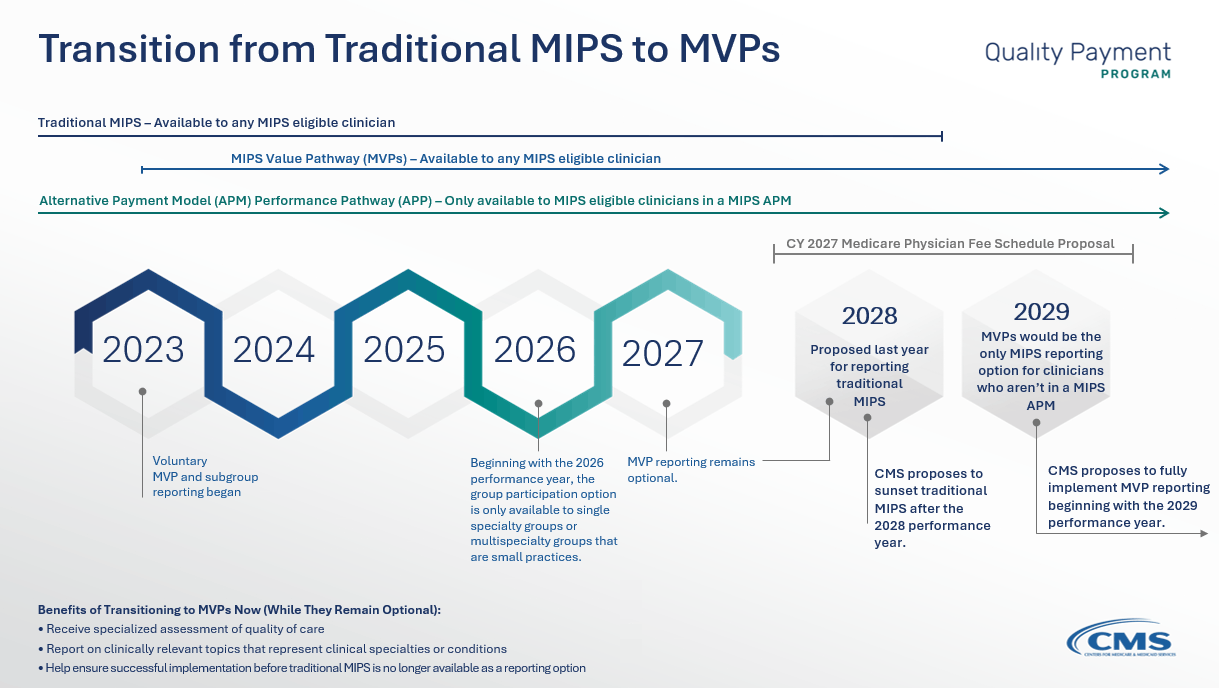
Source: Centers for Medicare & Medicaid Services (CMS)
Utilizing the current transition window to test your specialty’s MVP ensures your team avoids sudden compliance scrambles when the old system officially sunsets.
| Feature | Traditional MIPS | MIPS Value Pathways (MVPs) |
| Scope of Selection | A massive, overwhelming catalog of unlinked measures. | A curated, specialty-specific collection of related metrics. |
| Reporting Experience | Fragmented, requiring a chaotic scramble at year-end. | Connected, longitudinal tracking of a patient’s care journey. |
| Peer Benchmarking | Broad, cross-specialty comparisons that often lack context. | Direct peer groups managing identical medical conditions. |
| Future Outlook | On its way out as CMS phases it down. | The clear future standard for value-based care reporting. |
You no longer have to waste time wrestling with metrics that don’t fit your clinic. MVPs let your team concentrate on the exact clinical indicators that match your daily work.
Fewer choices mean less analysis paralysis. Your team can stop spending weeks trying to decode measure specifications and just focus on clear, established pathways.
Because MVPs look at the bigger picture of patient health, your practice finally gets credit for the long-term, high-quality care you provide every day.
When your quality reporting mirrors your actual internal goals, compliance stops feeling like an external punishment and starts supporting your clinic’s growth.
Adopting MVPs early gives your practice a predictable routine. As healthcare policies keep shifting, having a steady framework keeps your team calm and prepared.
Changing how your clinic reports shouldn't mean taking your eye off your patients. P3Care steps in to handle the heavy lifting of revenue cycle management and quality reporting. Our team works alongside your staff to align your EHR workflows, clean up your measure selection, and protect your Medicare reimbursements from unexpected hits.
Schedule MVP Transition Consultation
Any big regulatory shift comes with growing pains. As your practice moves toward MVPs, you might run into a few bumps along the way:
Check your numbers first. Make sure your individual providers or group practices meet the patient volume thresholds that make participation necessary.
Take a look at the current catalog of CMS-approved pathways and find the one that fits your core specialty or your most common patient diagnoses.
Sit down with your team and look closely at the mandatory quality measures, improvement activities, and cost elements tucked inside your chosen pathway.
Take an honest look at your current EHR and billing software. Can your system easily pull and format the specific data points your MVP requires?
Run a quick internal audit before reporting starts. Find out where your current charting habits leave gaps compared to what the new pathway asks for.
Ditch the frantic December scramble. Set up simple monthly or quarterly check-ins so your team stays on top of data tracking naturally.
The best defense against reimbursement penalties is simply getting ahead of the curve. Start by looking back at your historical MIPS scores to see where your clinic naturally shines. Next, call up your EHR vendor or IT partner to make sure their software is ready for MVP data aggregation. Most importantly, talk to your clinical staff early so that documentation habits shift naturally before mandatory deadlines roll around.
The writing is on the wall. CMS has made it clear through recent rulings that traditional MIPS is being phased out, making MVPs the permanent standard for Medicare reimbursement. Getting ahead of this transition isn’t just about following rules but about securing your practice’s financial health for the long haul.
Moving from traditional MIPS to MVPs is a logical step forward for modern healthcare. While change always brings a little friction, shifting toward clean, specialty-focused reporting ultimately makes life easier for providers and yields better care for patients. By checking your workflows early, getting your technology aligned, and leaning on experienced partners when you need them, your practice can walk into the future with total confidence.
P3Care connects the dots between complex federal mandates and smooth daily operations. Let our dedicated specialists manage your tracking and workflow mapping so you can focus entirely on doing what you do best: taking care of your patients.
Partner with P3Care Today
What is the difference between Traditional MIPS and MVPs?
Traditional MIPS lets you hunt through a massive catalog to pick unrelated measures. MVPs bundle related quality measures, improvement activities, and cost metrics into cohesive, specialty-specific pathways that make sense for your daily practice.
Are MVPs replacing Traditional MIPS?
Yes. The Centers for Medicare & Medicaid Services (CMS) has laid out a clear timeline to completely sunset traditional MIPS, making MVPs the required framework for value-based quality reporting.
Do all MIPS-eligible clinicians have to participate in an MVP?
CMS has phased the transition with voluntary windows to help practices adjust, but the long-term regulatory direction points straight toward mandatory adoption as old options disappear.
How do I know which MVP is right for my specialty?
You can review the official list of approved pathways via the Quality Payment Program Resource Library to find the option that matches your primary clinical focus.
How can a practice prepare for the transition from Traditional MIPS to MVPs?
Start by auditing your current EHR capabilities, reviewing past reporting strengths, training your clinical staff on specialty-specific documentation, and partnering with experienced healthcare management teams to smooth out the operational details.