

You delivered the care. The claim went out. Sixty days later, the payment is still missing. That gap is your accounts receivable (AR) in medical billing, and it decides whether payroll clears on time. This guide explains what AR is, how the AR process works, which numbers to watch, and which 2026 changes put your cash flow at risk. Each section opens with a direct answer you can act on in minutes.
AR in medical billing is the money owed to your practice for care already delivered. It sits in two buckets:
A balance enters AR when the claim is submitted and leaves when payment posts or an approved adjustment clears it. Insurance AR needs appeals and documentation. Patient AR needs clear statements and payment options. AR looks like an asset on paper and behaves like a liability the longer it ages.
The AR process runs from patient registration to a zero balance in eight steps:
Industry research puts potentially avoidable denials near 86 percent. Steps 1 to 3 hold the biggest savings. A tight revenue cycle management workflow protects all eight.

Aim for days in AR under 40. The AAFP treats 50 days as the ceiling and 30 to 40 days as preferred.
Days in AR = total AR ÷ average daily charges. With $450,000 in AR and $10,000 in daily charges, your days in AR is 45.
One number hides problems. Track four together:
Run days in AR by payer, not only for the whole practice. One slow payer can hide behind a healthy average.

Claims age from front-end errors, slow follow-up, and unworked denials. Match the action to the age:
| AR age | Common cause | Best action |
| 0-30 days | Claim not received, clearinghouse edits | Confirm receipt; check status at day 14 |
| 31-60 days | Missing information, pending prior authorization | Call or use the payer portal; send records; log the reference number |
| 61-90 days | Unworked denials, code mismatch, underpayment | Correct and resubmit; file the appeal; escalate to a payer rep |
| 91-120 days | Timely-filing risk, lost claims | Send proof of timely filing; start with the highest dollars |
| 120+ days | Write-off risk | Final appeal; bill secondary; review patient responsibility |
Work claims by dollar value and deadline, not by claim order. A $3,000 claim with 20 days left before timely filing beats ten $80 claims.
Code mismatches and thin documentation create the denials that age in AR. Watch these:
Verify every code against the CDC ICD-10-CM files, the AMA CPT resources, and payer policy. Our medical coding services team reviews code pairs before claims leave. Our care management programs cover CCM and RPM services.
Four shifts hit collections this fall:
Fix the front end, automate status checks, and hand aged accounts to specialists.
P3Care supports each step. Our accounts receivable management team works aged claims. Denial management services find root causes. P3Merge, our billing software, supports daily claim tracking. Credentialing services close enrollment gaps that trigger denials. A medical billing audit finds hidden revenue leakage. Practices in Texas, California, and Nevada get state-aware billing support.
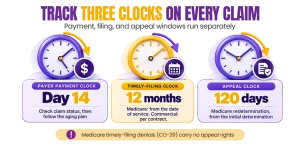
AR is the pulse of your practice. Keep days in AR under 40, work claims by age and dollar value, prepare for the October 1 code change, and track all three clocks. Small front-end fixes save the most money later.
P3Care's revenue cycle team reviews your aging report, spots denial patterns, and builds a follow-up plan for stuck claims.
Schedule a Consultation
What does AR mean in a medical billing job?
An AR analyst works the aging report, calls payers, checks claim status, and reworks denied claims until the balance is paid or adjusted.
Is AR follow-up the same as denial management?
No. AR follow-up chases unpaid and pending claims. Denial management finds why claims failed, files appeals, and stops the same denial from returning.
When is it safe to write off an AR balance?
Write off only after the final appeal, secondary billing, and patient responsibility steps are complete and documented under a written policy. Routine waivers of copays or deductibles can breach payer contracts.
Does outsourcing AR follow-up put patient data at risk?
Not when the vendor signs a business associate agreement and follows HIPAA safeguards. Confirm access controls, audit logs, and breach procedures. See how HIPAA medical billing works at P3Care.
Which reports do AR teams use every day?
The aging report by payer, the denial report, the clearinghouse rejection report, remittance files, and an unbilled claims report. The unbilled report catches charges that never became claims.