


Open enrollment hands you five acronyms and ten minutes to pick one. Choose wrong, and a routine specialist visit turns into a denied claim, a surprise bill, or a referral you didn’t know you needed.
This guide explains what an HMO, PPO, POS, EPO, and HDHP actually cover, what each one costs, and how your plan type changes the way your claim gets coded, submitted, and paid. Patients need this to avoid bills they didn’t expect. Medical practices need it to stop losing revenue to preventable denials.
A Health Maintenance Organization (HMO) ties your care to one primary care physician (PCP). Your PCP manages routine visits and writes the referral you need before a specialist appointment gets covered.
HMOs work well for patients who see one main doctor, live near their network, and don’t need frequent specialist access. Network rules are laid out directly on HealthCare.gov.
A Preferred Provider Organization (PPO) drops the referral requirement. You can see any in-network or out-of-network provider directly, though out-of-network care costs more.
The latest KFF Employer Health Benefits Survey found 46% of covered workers are enrolled in a PPO, making it the most common plan type in the country. Employees who see multiple specialists, travel often, or want an out-of-network fertility, mental health, or specialty provider tend to pick a PPO despite the higher premium.
A Point of Service (POS) plan borrows from both. You pick a PCP and need a referral for in-network savings, like an HMO. You can still step outside the network, like a PPO, at a higher out-of-pocket cost.
An Exclusive Provider Organization (EPO) covers in-network care only, like an HMO, but most EPOs drop the referral requirement, like a PPO. Networks also tend to run larger than a typical HMO’s. A deeper explanation of network-only plans is available from MedlinePlus, part of the National Institutes of Health.
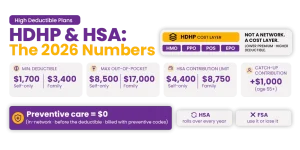
A High Deductible Health Plan (HDHP) isn’t a network type; it’s a cost structure layered onto an HMO, PPO, POS, or EPO. Lower monthly premiums come paired with a higher deductible before the plan starts paying its share.
For 2026, the IRS raised the minimum HDHP deductible to $1,700 for self-only coverage and $3,400 for family coverage, and the maximum out-of-pocket limit to $8,500 for self-only and $17,000 for family coverage (Rev. Proc. 2025-19). HSA contribution limits climb to $4,400 for individuals and $8,750 for families, plus a $1,000 catch-up contribution for enrollees 55 and older.
An HDHP unlocks a Health Savings Account (HSA), a tax-advantaged account that rolls over every year, unlike a use-it-or-lose-it FSA. One detail catches most patients off guard: in-network preventive care is covered at 100% even on an HDHP, before the deductible is met. Getting that $0 bill right depends entirely on how the visit is coded, covered below.
| Plan Type | Referral Needed | Out-of-Network Coverage | Typical Premium | Best For |
| HMO | Yes | Emergency only | Lowest | One main doctor, budget-focused patients |
| PPO | No | Yes, at higher cost | Highest | Frequent specialist visits, travelers |
| POS | Yes | Yes, at higher cost | Moderate | Patients who want a PCP plus flexibility |
| EPO | Usually not | Emergency only | Moderate-high | Direct specialist access, in-network patients |
| HDHP | Depends on base plan | Depends on base plan | Lowest monthly cost | Healthy patients who want HSA tax savings |

This is the part patients never see, and most guides never mention: plan type doesn’t just decide what you pay; it decides how the claim has to be filed.
HMO and POS claims need a referral or prior authorization number. That number belongs in Box 23 of the CMS-1500 claim form, which, per CMS instructions, is also where billers report the referral number, mammography pre-certification number, or CLIA number when those apply. Leave Box 23 blank or mismatched, and the claim denies, no matter how accurate the rest of the coding is.
PPO and EPO claims skip the referral field but still need correct place-of-service and network-status coding, since out-of-network claims run through a different fee schedule and often trigger balance billing rules the patient needs to understand upfront.
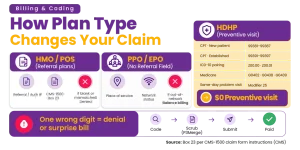
HDHP preventive claims live or die on code selection:
One wrong digit in any of these fields turns a $0 preventive visit into a patient balance, or a covered specialist visit into a denial letter. That’s the gap between a claim being submitted and a claim being paid, and it’s where eligibility verification and denial management earn their keep. Automated claim scrubbing, like the kind built into P3Merge, catches a missing referral number or mismatched modifier before the claim reaches the payer, not after a 30-day denial cycle. Practices without that safety net often rely on outsourced medical billing services and medical coding services to keep this level of detail from slipping through, while staying compliant with HIPAA medical billing standards on every claim touched.
Choosing between an HMO, PPO, POS, EPO, or HDHP affects more than premiums and deductibles. Each plan has different rules for referrals, network coverage, authorization, preventive care, and claim processing. Understanding these differences helps patients avoid unexpected costs and helps medical practices reduce preventable claim denials.
For healthcare providers, accurate eligibility verification, medical coding, claim submission, and denial management are essential for getting paid correctly and on time. A small error, such as a missing referral number or incorrect modifier, can delay reimbursement and create unnecessary patient balances.
Whether your practice handles HMO, PPO, POS, EPO, or HDHP claims, having the right billing processes in place can protect revenue and improve the patient billing experience.
P3Care helps healthcare practices manage medical billing, coding, claims, and denial management more efficiently.
Get a Free Consultation
Can I switch from an HMO to a PPO mid-year?
Generally no. Plan changes are locked to open enrollment or a qualifying life event like marriage, a new baby, or a job change.
Is an HDHP the same thing as an HSA?
No. The HDHP is the insurance plan; the HSA is the optional tax-advantaged savings account you become eligible to open because of it.
Which plan type is cheapest overall?
Depends on usage. HMOs and EPOs keep premiums and copays low; HDHPs keep premiums lowest of all but expose you to more cost before the deductible is met.
What happens if a provider bills a claim without a required referral or authorization number?
The payer typically denies it. The practice must appeal or resubmit with the correct Box 23 information, and the patient may see a bill in the meantime.
Does an EPO ever cover out-of-network care?
Only in a true emergency. Outside of that, it works like an HMO: in-network or nothing.
Are preventive visits really free on every plan, including an HDHP?
Yes, for in-network preventive care under ACA rules, but only when billed with the correct preventive code and diagnosis pairing, not a standard office-visit code.